The 160-Year-Old Coal Observation That Explains Your AI Anxiety
I adore good paradoxes, I find them delightful. Two statements that seem to cancel each other out but in fact reveal a deeper truth: finance and economics is full of them. There’s the Paradox of Thrift (good personal financial advice makes for bad policy), and the Allais Paradox (we humans rarely make rational choices consistently, preferring certainty over what we recognize as a risk, even if it isn’t), just to name two. Have you heard about Jevons’ Paradox? If not, get ready, because it’s about to be everywhere. It’s illustrated beautifully by Jono Hey:

William Jevons observed in 1865 that as coal usage efficiency increased, people burned more coal overall, not less, contrary to expectations: it turned out that better efficiency meant more people could use it, so more people used it.
This phenomenon is playing out in real time now in AI: there’s a fear of AI as a job killer, but what might be happening is that AI is enabling more work to happen, not less, Here’s a chart by economist Torsten Slok of Apollo, who’s been studying the impacts across various industries:
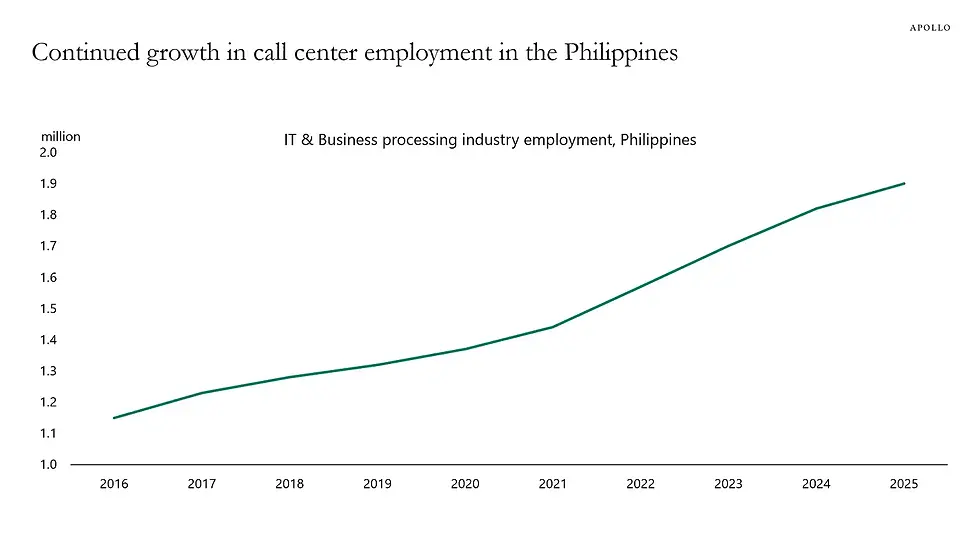
This is worth grappling with right now. If Jevons is right, then every efficiency gain AI delivers -- faster research, automated workflows, accelerated decision-making -- wouldn’t reduce the total demand for human effort. A lawyer who can draft contracts in a third of the time doesn’t go home early; she takes on more clients and there are more clients for everyone to take on. A financial advisor (hi!) who can generate reports in minutes doesn’t work less; she serves more households. I often tell my clients that naturally, our expenses will somehow increase to meet higher income, and our ability to accumulate stuff will somehow expand when we move into a bigger home. Putting in a guardrail to have this happen with some intentionality is a big part of my job. I suspect this will be no different: the output ceiling rises, and we fill the space.
That’s either exciting or alarming, depending on your point of view. But Jevons wasn’t being pessimistic. His observation wasn’t that efficiency is bad, it was that efficiency alone doesn’t get you the outcome you’re hoping for if the goal is reduction. The lever that actually moves the needle is intervention: policy, incentive design, structural constraint.
The history of energy economics suggests we should start thinking about it now, before the rebound effect is too large to course-correct. The question isn’t whether AI will change how we work. It’s whether we’ll make good choices about what we do with the room it creates.


Comments